Productivity Emerges Where Competence Becomes Measurable
Why Companies Should Continuously Capture Learning Demand
Productive organizations stand out not because they run more trainings, but because they have a higher density of competence: employees work efficiently when they can reliably master the systems, processes, and tools relevant to their role and do so sustainably, not only at the moment of an initial rollout.
In many companies, learning is still tied to events: new software, new processes, new regulatory requirements. Upskilling happens selectively, not systematically. The result is a gradual loss of competence that only becomes noticeable once productivity, quality, or speed begins to decline.
New Healthcare takes a different approach with its learning products: the focus is not on training, but on measurable competence. Learning demand is made visible continuously and development is steered deliberately.
The Blind Spot of Traditional Training
One-off trainings can create knowledge, but they do not create lasting confidence in action. There are structural reasons for this:
- Knowledge becomes outdated faster than ever. Systems evolve continuously, processes are adjusted, and new functions are introduced. Without ongoing qualification, usage gaps emerge.
- Organizations are not static. Roles change, teams grow, and employees come and go. Competence levels drift apart, usually unnoticed.
- Requirements arise outside the company. Compliance, IT security, or quality standards require regular skill updates.
What’s missing is a mechanism that continuously answers where competence exists, where it is lacking, and where action is required. Without this transparency, learning remains unspecific or ineffective.
Managing Competence Instead of Distributing Training
Modern employee development follows a clear principle: don’t plan content. Define and monitor competence levels. New Healthcare makes this possible by offering products that systematically measure the learning journey on two complementary levels:
- Competence diagnostics within the learning system: While employees learn, integrated diagnostic technologies—especially from Area9—capture their actual level of knowledge. Tests, simulations, or adaptive tasks show precisely which topics are mastered confidently and where uncertainty remains. Based on this, personalized learning paths are created that adjust dynamically and close gaps deliberately.
- Competence validation in the work context: At the same time, competence is assessed where it matters: in work outcomes. If target values are not reached, it becomes possible to differentiate whether the cause lies in the process, the system, or the application. If deficits in usage are identified, learning can be triggered immediately.
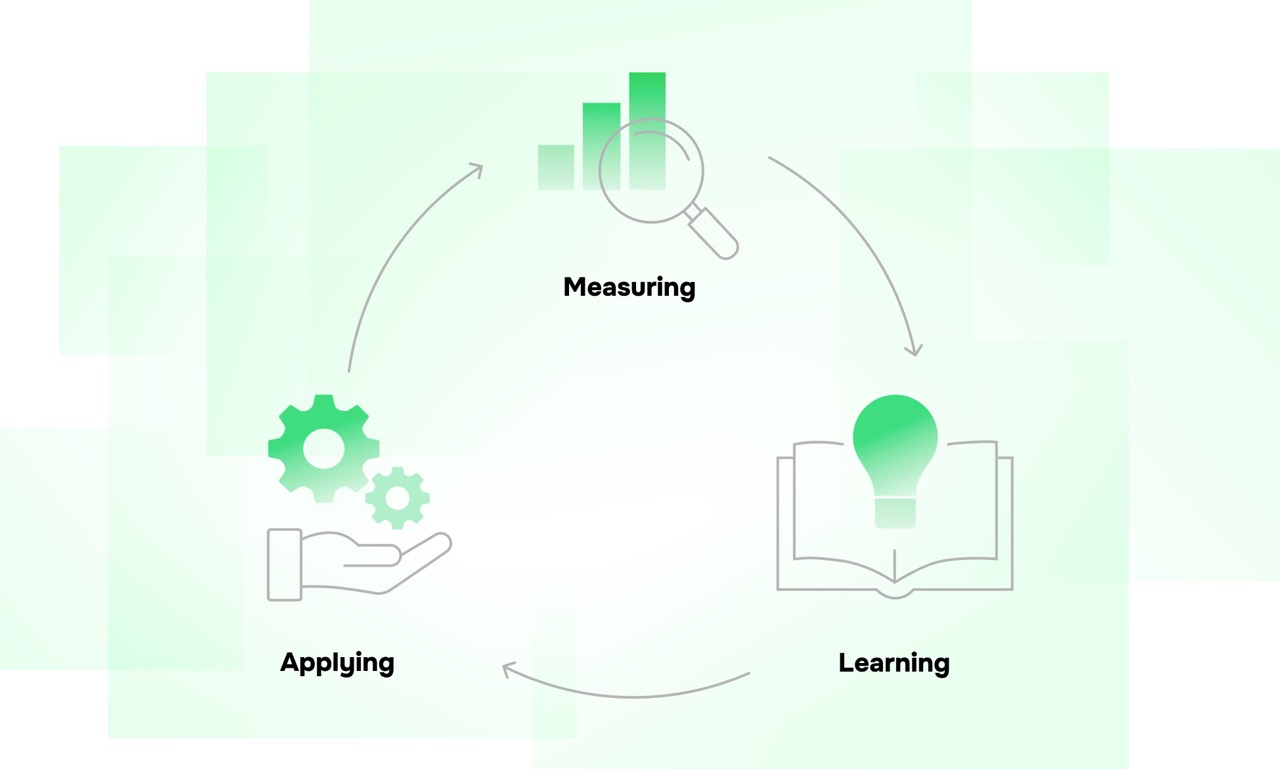
This creates a closed loop of measuring, learning, and applying, fully data-driven.
Scaling Learning Where Expertise Is Scarce
The value of this approach becomes particularly clear in highly specialized fields. In medical education, for example, adaptive learning platforms are used to develop and continuously validate knowledge and skills individually: at the University of St. Gallen, a digital learning environment with adaptive courses and personalized learning paths was established for surgical training.
Theory, simulations, and regular knowledge diagnostics are largely completed in a self-directed way.
The result: residents and students reach the required competence level significantly faster, while experienced surgeons can be involved precisely where their expertise creates the greatest value. Learning time is used more individually, and mentoring remains in place, while being deployed more efficiently.
This principle is universally transferable wherever productivity depends on the confident use of complex systems.
What Continuously Measured Competence Means for Companies
Organizations that continuously capture learning demand and steer development systematically gain structural advantages:
- Faster time-to-proficiency: Employees reach full competence in their role sooner.
- Greater adaptability: New requirements can be addressed in a targeted way without jeopardizing current performance.
- Stable quality: Confident handling of tools and processes reduces errors and friction.
- Efficient use of resources: Learning time goes into relevant content—not repetitions or guesswork.
Competence thus becomes a controllable variable, not a matter of chance.
Learning as the Organization’s Operating System
In a dynamic working world, learning is no longer an add-on. It is an integral part of value creation. What matters is not how much is learned, but how precisely learning demand is identified and addressed.
New Healthcare stands for this new logic of employee development. Our products enable employees, systems, and organizations to remain continuously capable through measurable learning demand, adaptive learning paths, and sustainable competence development.
This is how productivity emerges: not through more training, but through systematically achieving the highest possible competence level in every role.
Start now with a free consultation and product demo and discover how your organization can benefit from our solutions.